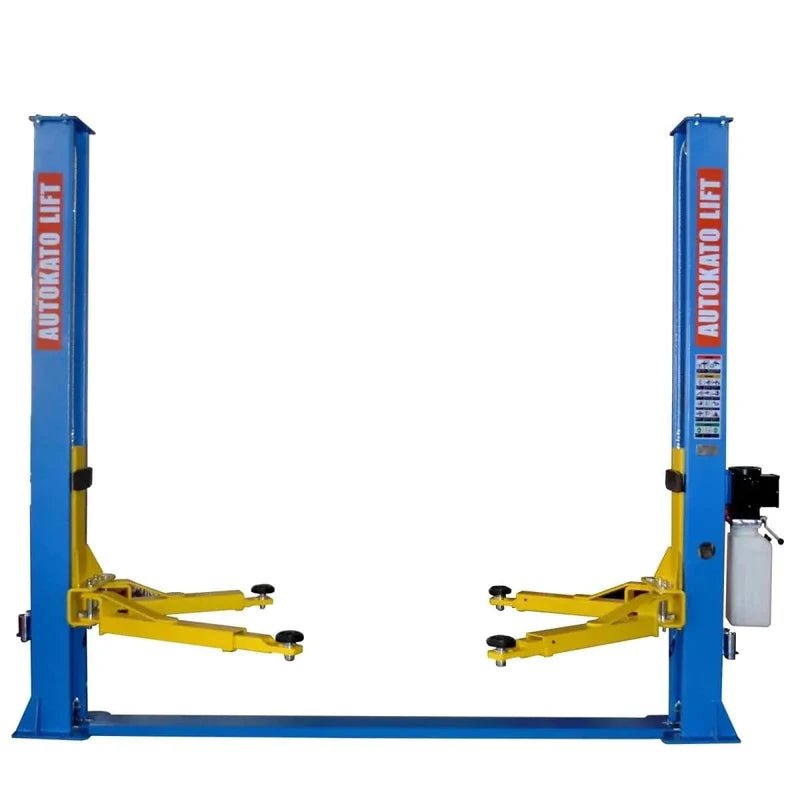
This guide covers Katool lift reviews across every current two-post model, including real owner feedback, ALI vs CE certification explained, concrete requirements, and honest comparisons to help you decide if a Katool car lift is right for your garage.
So you're looking at Katool lifts and wondering if they're legit. Maybe you saw the price, did a double-take, and thought... okay, what's the catch?
I get it. You're about to drop somewhere between $1,900 and $4,300 on a piece of equipment you're literally going to stand underneath. That's not a decision you make lightly. And when the brand isn't BendPak or Rotary - names you've probably seen in every shop you've ever walked into - it's natural to be skeptical.
Let's cut through it. I'll tell you what Katool does well, where it falls short, who should buy one, and who should probably spend more on a premium brand. No fluff.
One thing worth mentioning upfront: we sell Katool, but we also work with customers who end up choosing ALI-certified lifts from other manufacturers when their situation calls for it. We'd rather steer you to the right lift than sell you the wrong one. Browse our full Katool two-post lift collection →
Who Actually Makes Katool Lifts? And Where?

Let's get this out of the way first because everyone asks: Katool lifts are manufactured in China.
I know. That word makes some people close the browser tab immediately. But here's the thing. So are a lot of the lifts you're cross-shopping. Atlas, Tuxedo, Triumph, most of the "value" brands... they're all coming from Chinese factories. Even some components in premium American brands are sourced overseas.
The real question isn't "where is it made?" It's about quality control, who's standing behind it, and whether you can get parts and support when you need them.
As for who owns Katool: it's a Chinese automotive equipment manufacturer (also known as Autokato) that sells directly into the U.S. market through domestic distribution. They're not a subsidiary of a larger brand you'd recognize.
Katool ships from a network of U.S. warehouses, including California and Texas. They have stateside phone support. Parts are stocked domestically. That matters more than the country of origin, honestly.
Are Katool Lifts Any Good? (Quality + Owner Feedback)
A common question we hear: are Katool lifts any good? I've spent a lot of time in the forums (GarageJournal, Grassroots Motorsports, Reddit, the usual places gearheads argue about this stuff. Here's the consistent pattern from real-world owner feedback (common themes: fit/finish better than expected, manual is thin, ALI confusion persists):
What people like:
- "Better than expected for the money" comes up constantly. Owners describe the steel as surprisingly beefy, welds cleaner than they anticipated, overall build quality exceeding what they assumed for the price point.
- Feature density. Single-point lock release, included adapter kits, stackable height extensions. Stuff you'd pay extra for with other brands comes in the box.
- Low-ceiling solutions. The base plate models (H100, H105, H115Z) exist specifically because a lot of garages can't fit an overhead two-post. People buy these because they have to, and they're generally happy they found an option that works.
What people complain about:
- Instructions can be rough. The manual gets you there, but most owners end up watching YouTube install videos or calling support to fill in the gaps.
- ALI certification confusion. More on this below.
- Brand trust anxiety. On GarageJournal, you'll see people recommend Rotary or Challenger almost reflexively, even when someone's budget clearly can't handle it. There's a psychological comfort in legacy brands that Katool just doesn't have yet.
One quote that stuck with me from an AR15.com thread (yeah, gun guys talk about lifts too): a user said his Katool 11K was "way higher quality than expected" and it lifted his 9,000 lb van without any drama.
That's kind of the theme. People expect budget quality, get something noticeably better, and feel pleasantly surprised. (Worth noting: forum discussions skew toward DIY and home garage installs - commercial shop feedback is harder to find.)
Are Katool Lifts ALI Certified?
No. Katool lifts are CE certified, not ALI certified. This is the most common question we get, so let me break it down clearly.
What CE certification means: The lift has been tested by a third party to European safety standards, including 115% dynamic load and 150% static load capacity. That's documented, verified testing. Not just the manufacturer saying "trust us, it's strong."
What ALI certification means: The lift meets ANSI/ALI ALCTV standards, which is the North American automotive lift industry standard. It's administered by the Automotive Lift Institute and is widely recognized by commercial insurers, OSHA, and municipal inspectors in the U.S.
Here's the honest reality:
If you're putting this lift in a commercial shop, call your insurance company first. Seriously. Some insurers require ALI certification specifically. Some landlords require it. Some local inspectors want to see it. If any of those apply to you, Katool is probably a non-starter. Not because the lift is unsafe, but because you'll have compliance headaches.
If you're putting this in your home garage? ALI certification is largely irrelevant. Home installs typically aren't inspected the way commercial bays are. But if you've got any doubts, a quick call to your insurer is cheap peace of mind.
Bottom line: Don't let forum warriors scare you off Katool for your home garage because of ALI. But if you're running a business, verify your requirements before you buy. If you need ALI certification for insurance or inspections, look at ALI-certified options from BendPak, Rotary, or Challenger.
Two-Post Lift Concrete Requirements (Thickness, PSI, Footers)
This is where lifts fail. Not the lift itself - the foundation underneath it.
Most Katool two-posts call for ~6 inches of reinforced concrete at 3,000 PSI minimum. Always verify the exact requirement in the manual for your specific model - specs can vary slightly.
The concrete checklist:
- Thickness: 5.9" to 6" minimum, reinforced with rebar or wire mesh (6.5" for the 15,000 lb M150D)
- Strength: 3,000 PSI minimum compressive strength
- Condition: No cracks, spalling, or deterioration where anchors will go
- Age: New concrete should cure at least 28 days before anchor installation
Many residential garages only have 4-inch slabs, which doesn't meet the 6-inch requirement. Don't give up. A common workaround is to "cut and pour" footers. You cut out two 3'x3' squares of concrete where the columns will sit and pour deeper pads (8-12 inches) specifically for the lift posts. It adds cost and time, but it's a common solution many home garage owners use when slab thickness is the limiting factor.
If you don't know your slab specs, get it tested before you commit. A concrete contractor can core-drill a sample and tell you exactly what you're working with. It's cheap insurance against something going very wrong.
Which Two-Post Lift Is Safest?
Here's the honest answer: the safest lift is the one installed correctly on proper concrete. Brand matters less than installation quality. A $6,000 BendPak installed on a cracked 4-inch slab with under-torqued anchors is more dangerous than a $1,900 Katool installed correctly on a 6-inch reinforced slab with proper anchor embedment.
That said, ALI-certified lifts have passed third-party testing to North American standards, which gives you documented assurance. CE-certified lifts (like Katool) have also passed third-party testing, just to European standards. Both certifications verify the lift structure itself is sound. The failure point is almost always the installation, not the equipment.
When lifts fail catastrophically, it's almost always the concrete, the anchors, or overloading - not a manufacturing defect. Take installation seriously regardless of what brand you buy.
How Katool Compares to Other Brands
Let's be real about where Katool sits in the market.
Katool vs BendPak Two-Post Lift
BendPak is the gold standard for a reason. ALI certified across most models. Decades of reputation. Huge dealer and service network. Excellent resale value. They're also one of the few lift manufacturers that actually builds in the USA (Santa Paula, California), which matters to some buyers. If you need ALI certification or want the "nobody ever got fired for buying IBM" peace of mind, BendPak is the safe choice.
Katool costs roughly 40-60% less for comparable capacity. You're giving up ALI certification, brand prestige, and some fit-and-finish polish. For home garages without commercial requirements, that tradeoff often makes sense. For busy shops where downtime costs real money, BendPak's support network might be worth paying up for.
Katool vs Rotary Two-Post Lift
Rotary is another legacy name with serious commercial credibility. Their lifts are built like tanks and backed by extensive dealer support. They're also priced like premium equipment - often $5,000+ for a basic two-post.
The Katool comparison is similar to BendPak: you're trading brand recognition and ALI certification for significant cost savings. Rotary makes sense for high-volume commercial operations. Katool makes sense for home garages and small shops watching their budget.
Katool vs Atlas Two-Post Lift
Atlas is closer to Katool's price range - both are value-oriented imports with U.S. support. Atlas has some ALI-certified models in their lineup, which gives them an edge if you specifically need that certification but want to stay in the budget tier.
When comparing Katool to Atlas, it often comes down to which specific model has the specs you need (capacity, ceiling height, arm style) at the better price. Katool tends to include more accessories in the box. Compare specs, warranty terms, and what's included rather than assuming one brand is universally better.
The Real Question
Are any car lifts made in the USA? Yes - BendPak and Rotary both manufacture domestically, and Challenger has U.S. production as well. That's part of what you're paying for with premium brands. Most value-tier lifts (Katool, Atlas, Tuxedo, Triumph) are manufactured in China with varying levels of U.S. support infrastructure.
What are you paying for with premium brands?
- ALI certification (matters for commercial, doesn't matter for home)
- Brand reputation and resale value
- Larger installer and service network
- Slightly better fit and finish
- Peace of mind
If those things matter to your situation, pay up for premium. If they don't, Katool gets you a functional, safe, well-built lift for significantly less money.
Base Plate vs Clearfloor Two-Post Lifts (Which Should You Buy?)
This is one of the first decisions you'll make, and it's mostly dictated by your ceiling height.
Clearfloor lifts have an overhead beam connecting the two columns. Nothing on the floor between the posts. That means you can roll jacks, creepers, and transmission jacks around freely. They're taller overall, so they typically need ~14' ceilings to install comfortably. Whether you can stand upright under the raised vehicle depends on vehicle height and how high you lift it.
Base plate (floorplate) lifts anchor at floor level with no overhead connection. They're shorter overall - some fit under 10-foot ceilings. The tradeoff: you've got plates and sometimes cables on the floor between columns, which can be annoying when rolling equipment around.
Quick decision guide:
- Ceiling under 12 feet: Base plate is your only option. Look at the H100, H105, H115Z, or H120D.
- Ceiling 12-14 feet: Base plate models give you the most working height. Some clearfloor models might fit but leave limited headroom.
- Ceiling 14+ feet: Clearfloor is ideal. The M110, M120, AS110D, and AM120SD all work well. If you need more than 12K, the M140XD (14,000 lb) and M150D (15,000 lb) are clearfloor too, and the M150D wants closer to 15 feet.
Don't just measure ceiling height - account for the vehicle's raised height plus your own working clearance. A 12-foot ceiling sounds tall until you've got a truck raised 6 feet and you're trying to stand under it.
Best Katool Lift for Home Garage
If you're setting up a home garage, you're probably dealing with limited ceiling height (12 feet or less), standard residential 220V power (or maybe only 110V), a concrete slab you're not 100% sure about, and a mix of vehicles from daily drivers to weekend projects.
For most home garages, I'd point you to the Katool KT-H105.
It's got 10,000 lb capacity (handles most vehicles), fits under 12-foot ceilings, has good drive-thru clearance, and the dual-side safety release is convenient for solo work. It's the most popular model for home use and hits the sweet spot of capacity, size, and price.
If your ceiling is really tight (9-10 feet): Look at the KT-H100. Shortest overall height in the lineup.
If you need more capacity for heavier trucks: The H115Z gives you 11,000 lb in a low-ceiling package, plus a 3.9" minimum pad height for lowered cars.
Best Katool Lift for Auto Body Shops
Body shops have different needs than general repair. You're moving cars on and off the lift constantly, working around open doors and panels, and often dealing with vehicles that are lower than stock because they're missing wheels or suspension components.
For most auto body shops, I'd point you to the Katool AS110D.
Here's why it works for body work:
- Asymmetric arms: The rotated column design positions the vehicle so doors swing open without hitting the posts. When you're constantly opening doors to check panel gaps, repair hinges, or access interior trim, this matters.
- Low minimum pad height: Cars coming in for collision work are often sitting lower than normal - missing wheels, blown struts, or already on dollies. You need to get under them.
- Direct-drive hydraulics: No chains to maintain. Body shops are already juggling paint schedules, parts delays, and insurance adjusters. One less maintenance item helps.
- 11,000 lb capacity: Covers everything from Miatas to Suburbans. Most collision work is on passenger vehicles, but you'll occasionally get a truck or SUV.
If you need more capacity or have higher ceilings: The AM120SD gives you 12,000 lb with the same asymmetric arms and direct-drive cylinders, plus single-point lock release for faster cycling between vehicles.
One caveat for body shops: If you're doing frame work or need to lift vehicles by the body instead of the frame rails, a two-post might not be your best option. You might want to look at a four-post lift or a dedicated frame rack instead. Two-posts work great for bolt-on collision repair, paint prep, and general body work - but they're not frame machines.
Full Katool Two-Post Lift Comparison
Here's how all 10 models stack up side by side. Use this to compare specs quickly - capacity, ceiling requirements, drive-thru clearance, and key features. If you're not sure which category you fall into, this table will help you narrow it down before diving into the individual reviews below.
| Spec | KT-H100 | KT-H105 | H115Z | KT-H120D | KT-M110 | KT-M120 | AS110D | AM120SD | KT-M140XD | KT-M150D |
|---|---|---|---|---|---|---|---|---|---|---|
| Capacity | 10,000 lb | 10,000 lb | 11,000 lb | 12,000 lb | 11,000 lb | 12,000 lb | 11,000 lb | 12,000 lb | 14,000 lb | 15,000 lb |
| Style | Base Plate | Base Plate | Base Plate | Base Plate | Clearfloor | Clearfloor | Clearfloor | Clearfloor | Clearfloor | Clearfloor |
| Arm Config | Symmetric | Symmetric | Symmetric | Symmetric | Symmetric | Symmetric | Asymmetric | Asymmetric | See listing | Symmetric |
| Min. Ceiling (Install)* | ~9' 3" | ~10' | ~10' | ~9' 3" | ~14' | ~14' | ~14' | ~14' | ~14' | ~15' |
| Power | See listing | 220V | 220V | 220V | 220V | 220V or 110V build | 220V | 220V | See listing | See listing |
| Drive-Thru | 94.5" | 98.4" | 98.4" | See listing | 94.5" | 117.75" | 100" | 94" | 133" | 116.1" |
| Min. Pad Height | 4.25" | 3.9" | 3.9" | See listing | 4.25" | 4.25" | See listing | 4.25" | See listing | 4.33" |
| Single-Point Release | — | — | — | ✓ | — | — | ✓ | ✓ | See listing | — |
| Direct Drive (No Chains) | — | — | — | — | — | — | ✓ | ✓ | See listing | See listing |
| Best For | Low Ceilings Entry Price |
Home Garages (Most Popular) |
Lowered Cars More Capacity |
Low Ceiling Heavy Trucks |
Shops Mixed Vehicles |
Fleet Long Wheelbase |
Sedans Door Access |
High-Volume Door Access |
Heavy Trucks 14K Capacity |
Commercial Fleets 15K Capacity |
*Min. Ceiling = approximate ceiling height required to install and operate the lift structure. Actual headroom under a raised vehicle varies by vehicle height and how high you lift it.
The "minimum ceiling height" in the table is the approximate height needed to install and operate the lift itself. Actual headroom under a raised vehicle depends on your vehicle's roof height and your working height. For tight garages, measure your tallest vehicle and plan extra clearance for lights, openers, and ducting.
Katool Two-Post Lift Model Reviews
Katool makes ten two-post lifts. They break down logically once you understand the key variables: capacity (10K to 15K), style (base plate vs clearfloor), and arm configuration (symmetric vs asymmetric). Here's a detailed look at each model.
Katool KT-H100 Review
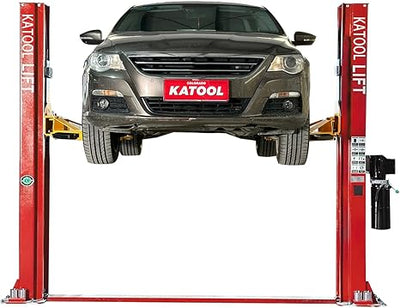
Katool KT-H100
10,000 lb capacity | Base Plate
The most ceiling-friendly option. At 110.25 inches tall, it can fit in some 9-10 foot spaces. Dual-side manual safety release, dual chain-drive cylinders, and a 94.5-inch drive-thru. Good entry point for home use.
Best for: Garages with very low ceilings
Who should avoid: Anyone needing more than 10K capacity or planning to lift trucks regularly
View Details →Katool KT-H105 Review
Katool KT-H105 Most Popular
10,000 lb capacity | Base Plate
Slightly more drive-thru clearance (98.4") and longer arm reach than the H100. Dual-side manual safety release so you can lower from either column. The one most home garage buyers land on.
Best for: Home garages with 12-foot ceilings, solo DIYers who want dual-side release
Who should avoid: Commercial shops needing ALI certification
View Details →Katool H115Z Review

Katool H115Z
11,000 lb capacity | Base Plate
The low-ceiling option with more capacity. Standout feature: 3.9-inch minimum pad height, which is great if you're lifting lowered cars or sports builds that can't clear standard 5"+ pads.
Best for: Lowered vehicles, sports cars, heavier SUVs in low-ceiling garages
Who should avoid: Anyone who doesn't need the extra 1,000 lb capacity over the H105
View Details →Katool KT-H120D Review
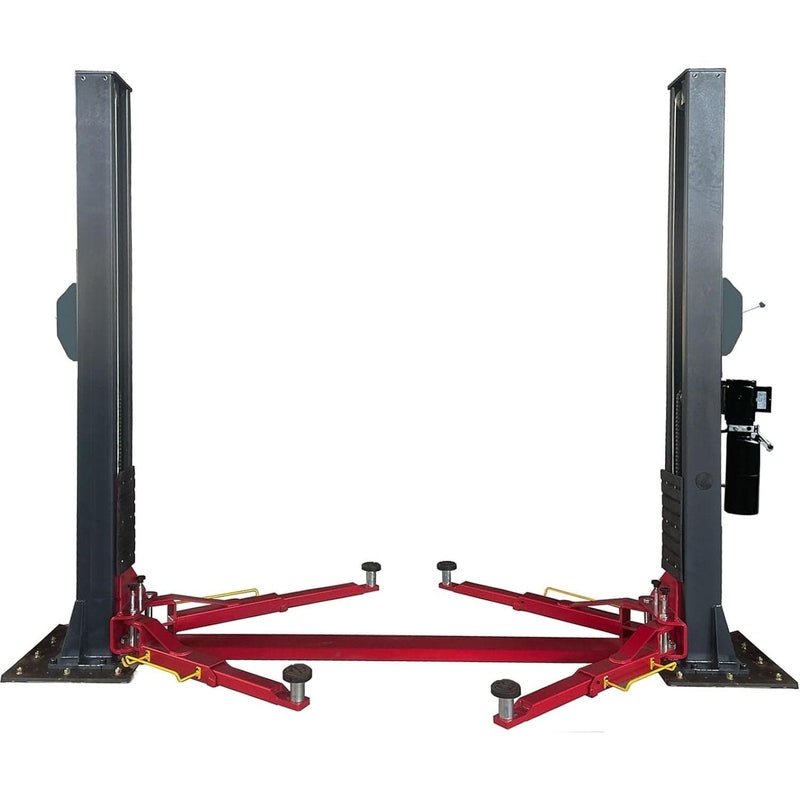
Katool KT-H120D
12,000 lb capacity | Base Plate
Full 12K capacity without needing a 14-foot ceiling. Single-point lock release for faster workflow. If you're lifting trucks and vans in a space that can't fit an overhead lift, this is your move.
Best for: Heavy trucks and vans in garages under 14 feet, single-tech operations
Who should avoid: Anyone who can fit a clearfloor lift (they're easier to work around)
View Details →Katool KT-M110 Review

Katool KT-M110
11,000 lb capacity | Symmetric Clearfloor
Clean floor, nothing to step over. 20 lock positions at 2.8-inch intervals for dialing in exact working height. Solid all-arounder for a shop doing mixed passenger vehicles and light trucks.
Best for: Shops with tall ceilings wanting unobstructed floor space
Who should avoid: Home garages with ceilings under 14 feet
View Details →Katool KT-M120 Review
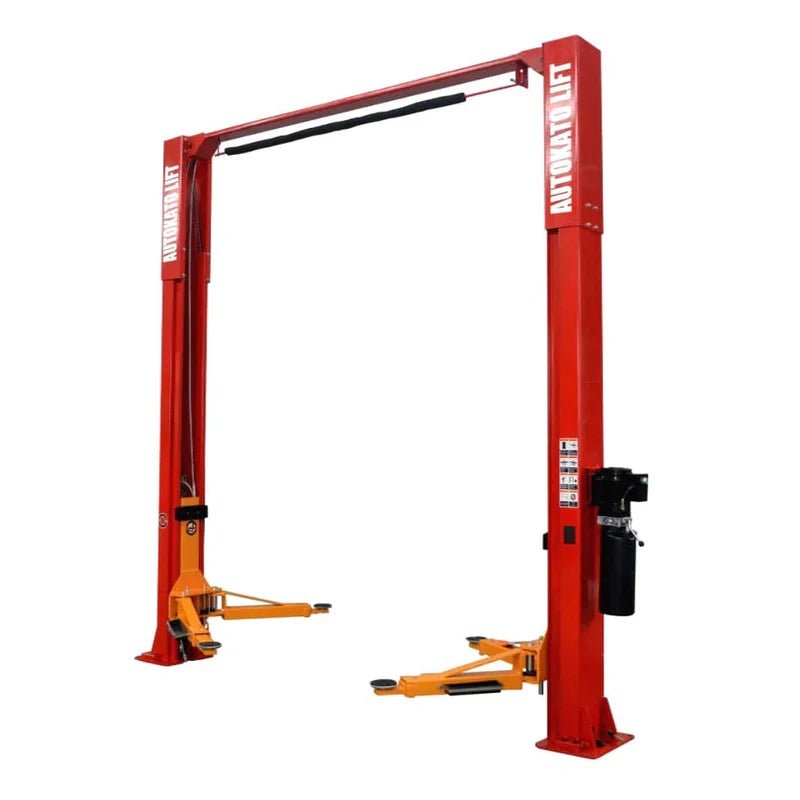
Katool KT-M120
12,000 lb capacity | Symmetric Clearfloor
The biggest capacity in a clearfloor config. Triple-telescoping arms for long-wheelbase trucks and vans. Extra-wide 117.75" drive-thru. If you're servicing fleet vehicles or full-size trucks daily, this is the one.
Best for: Fleet service, full-size trucks, commercial vans, long-wheelbase vehicles
Who should avoid: Home garages or anyone who doesn't need 12K capacity
View Details →Katool AS110D Review
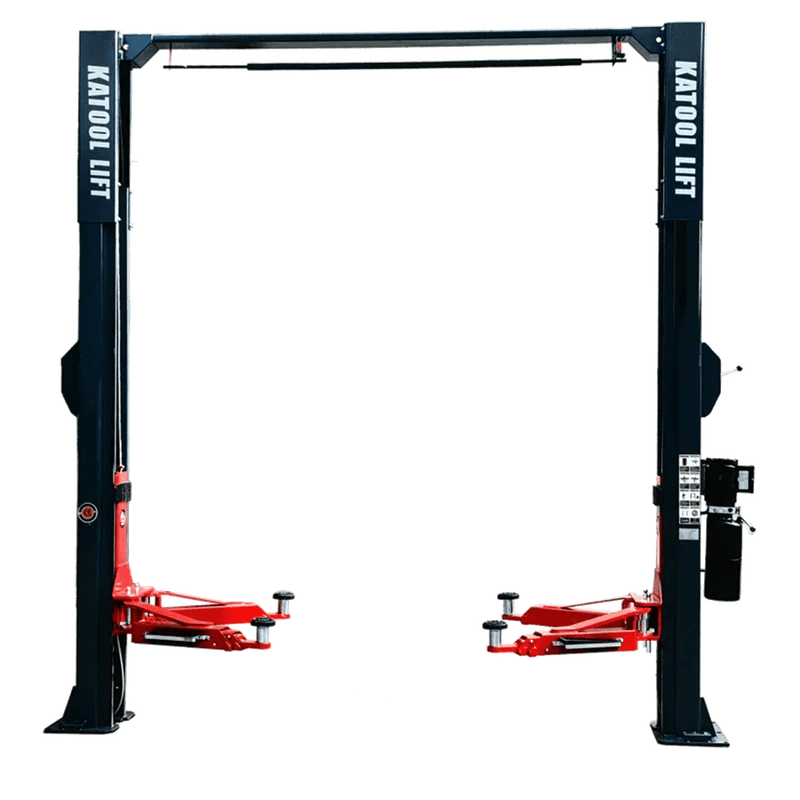
Katool AS110D
11,000 lb capacity | Asymmetric Clearfloor
One of two asymmetric lifts in the lineup (the AM120SD is the other). Better door clearance for sedan work. Direct-drive hydraulics (no chains) means less maintenance long-term. If you're doing a lot of brake jobs and interior access, the asymmetric layout is nice.
Best for: Sedan-heavy shops, frequent door-open work, anyone wanting lower maintenance
Who should avoid: Primarily truck shops (symmetric is better for heavier front-biased vehicles)
View Details →Katool AM120SD Review
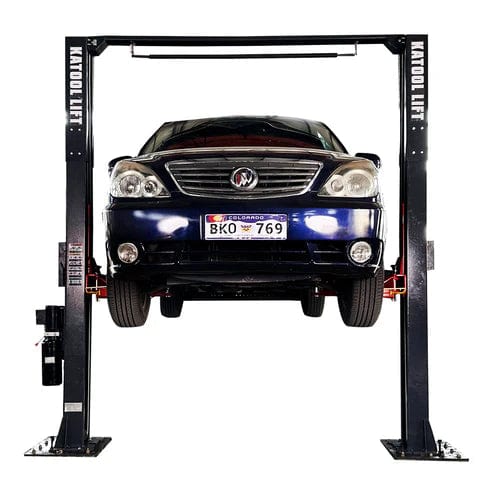
Katool AM120SD
12,000 lb capacity | Asymmetric Clearfloor
The commercial workhorse. Asymmetric three-stage arms and direct-drive cylinders like the AS110D, with 12 lock positions and a single-point lock release for one-tech operation. Built for high-volume shops doing trucks, SUVs, and fleet work. This is the one you'd compare against other budget 12K lifts in the same price range.
Best for: High-volume commercial shops, single-tech efficiency, heavy daily use
Who should avoid: Home garages (overkill for most residential use)
View Details →Katool KT-M140XD Review

Katool KT-M140XD
14,000 lb capacity | Clearfloor
The step up past 12K. A 4 HP motor, 72.83 inches of lifting height, and a 133-inch drive-thru, the widest in the lineup. Overall height is 167 inches, so plan on roughly a 14-foot ceiling.
Best for: Heavy trucks and vans that push past the 12K models
Who should avoid: Anyone the 12K models already cover
View Details →Katool KT-M150D Review

Katool KT-M150D
15,000 lb capacity | Symmetric Clearfloor
The heaviest rating Katool offers. Dual hydraulic cylinders with twin equalization cables, manual locks on both columns, a top limit switch, a 4.33-inch minimum pad height, and a 116-inch drive-thru. It needs 6.5 inches of concrete instead of 5.9, and at 176.77 inches tall it wants about a 15-foot ceiling.
Best for: Commercial shops running work trucks and full-size vans all day
Who should avoid: Home garages, or any bay that can't give it the ceiling and the slab
View Details →Katool Lift Warranty, Parts Availability, and Support
One of the biggest concerns with value brands is what happens when something breaks. Here's what Katool offers:
Warranty coverage:
- 3-year structural warranty covers columns, carriages, and frame components
- 1-year parts warranty covers hydraulics, cylinders, power units, and electronics
Extended warranties are available at purchase if you want more coverage.
Parts availability: Katool stocks replacement parts at its U.S. warehouses, and replacement warranty parts ship free. That's a real advantage over some imports where you're waiting weeks for parts from overseas.
Customer service: Stateside phone support during business hours. Multiple owners mention they're responsive, especially during installation when questions come up. The manual isn't perfect, but support can fill in the gaps.
Fine print: The warranty is non-transferable and requires your original order number, and registration may be required after purchase.
What's not covered: Labor. If something fails and needs a tech, you're paying for the service call. That's standard across the industry, not just Katool. For home garage owners who can turn a wrench, this is rarely an issue. For shops, factor potential service costs into your decision.
How Much Does a Katool Two-Post Lift Cost?
Prices move with sales and promotions. As of September 2026:
- 10K base plate models: $1,899 (KT-H105) and $1,999 (KT-H100)
- 11K models: $1,999 (H115Z) to $2,599 (AS110D), with the KT-M110 at $2,099
- 12K models: $2,599 (KT-M120) to $2,799 (AM120SD), with the KT-H120D at $2,699
- 14K and 15K models: $3,699 (KT-M140XD) and $4,299 (KT-M150D)
For context, a comparable BendPak or Challenger in the 10K to 12K range typically runs $4,000 to $6,000+. You're looking at roughly 40-60% savings with Katool, depending on the model.
Is it worth the savings? Depends on your situation. For a home garage or small independent shop without ALI requirements, probably yes. For a commercial operation where downtime costs real money and insurance wants specific certifications, you might want to pay up for that premium brand peace of mind.
Installation: Can You Do It Yourself?
Technically, yes. People do it all the time.
But here's my honest take: unless you're genuinely comfortable with concrete work, electrical, and you've got help moving 600 to 1,200 lbs of steel around, consider hiring it out.
What you need:
- Concrete verification: 5.9 to 6 inch minimum thickness, 3,000 PSI minimum strength (6.5 inches for the 15K M150D). If you don't know your slab specs, get it tested before you commit.
- Electrical: 220V single-phase for most models. Dedicated circuit. The KT-M120 is offered in a 110V build; confirm the voltage when you order.
- Equipment: Forklift or engine hoist for positioning. These things are heavy.
- Help: You're not doing this alone.
The most common DIY complaints I see are around anchor layout and leveling. Take your time. Follow the manual even if it's not perfect. Watch the YouTube install videos. Call Katool support if you get stuck - multiple owners mention they're responsive.
Power Unit Location and Hydraulic Routing
A common question during install planning: where does the power unit go and how do the hoses run?
The power unit (motor, pump, and reservoir) mounts directly to one column - the "power side." You'll install and anchor this column first, then connect the hydraulic lines. Hoses run from the power unit to the cylinder on that column, then route across to the off-side cylinder so both lift in sync.
The cables that equalize the lift run around pulleys inside the columns. The manual distinguishes between "power side cable" and "off-side cable" routing - follow this carefully so the cables move smoothly without interference. Once everything is routed, cover plates go over the hoses and cables to protect them from contact with moving parts.
It's not complicated, but it does require attention to detail. Rushing the hose and cable routing is where DIYers create problems for themselves later.
Shipping and Delivery
Katool two-post lifts ship LTL freight from U.S. warehouses. Fulfillment typically takes 6 to 10 business days, and seasonal delays can stretch delivery to about 3 weeks.
Unloading: Standard freight delivery is curbside and requires you to unload the crate (forklift, tractor forks, skid steer, or a loading dock). Liftgate service is not offered on Katool two-post lifts, so you need a forklift or equivalent on site when the truck arrives. Residential delivery is available for an added fee. Call us if you are not sure how you will unload.
Warehouse pickup: Pickup is available at select Katool warehouses. Call us to confirm which location can release your lift. This can reduce freight cost, but you'll still need a safe way to unload at your destination.
Inspect everything before signing the bill of lading. Note any visible damage on the paperwork, and report concealed damage or shortages within 48 hours. This protects your freight claim if something's wrong.
Should You Buy a Katool Lift?
✓ Yes, if:
- You're installing in a home garage or small independent shop
- You don't need ALI certification for insurance or inspectors
- Your concrete slab meets spec (5.9"+ thick, 3,000 PSI)
- You want maximum value per dollar
- You're okay with a lesser-known brand that delivers on quality
✗ No, if:
- Your insurer, landlord, or inspector requires ALI certification
- You need brand prestige for resale value or customer optics
- You want zero involvement in installation decisions
- You're not willing to verify your concrete specs
If you're unsure: Call us at +1 (855) 498-2147 before you buy. We'll help you figure out if Katool is the right fit or if you should be looking at something else.
The Bottom Line
Look, I'm not going to tell you Katool is as good as Rotary. It's not. You're trading brand prestige, ALI certification, and some fit-and-finish polish for significant cost savings.
But here's what I will tell you: for home garages and small shops without ALI requirements, Katool delivers real, usable, safe lifting capacity at a price point that makes actually owning a two-post lift accessible. The owners who buy them are consistently surprised by the quality. The people who install them correctly don't have problems.
The lift doesn't fail. The concrete fails. The anchors fail. The overloading fails. Do those parts right, and Katool will hold up its end.
If that math works for your situation, you'll probably be happy with it. If you need ALI or brand prestige, spend more elsewhere.
That's the honest answer.
Still have questions? We'll help you figure out the right lift for your space, your vehicles, and your budget.
Call (855) 498-2147
Share: