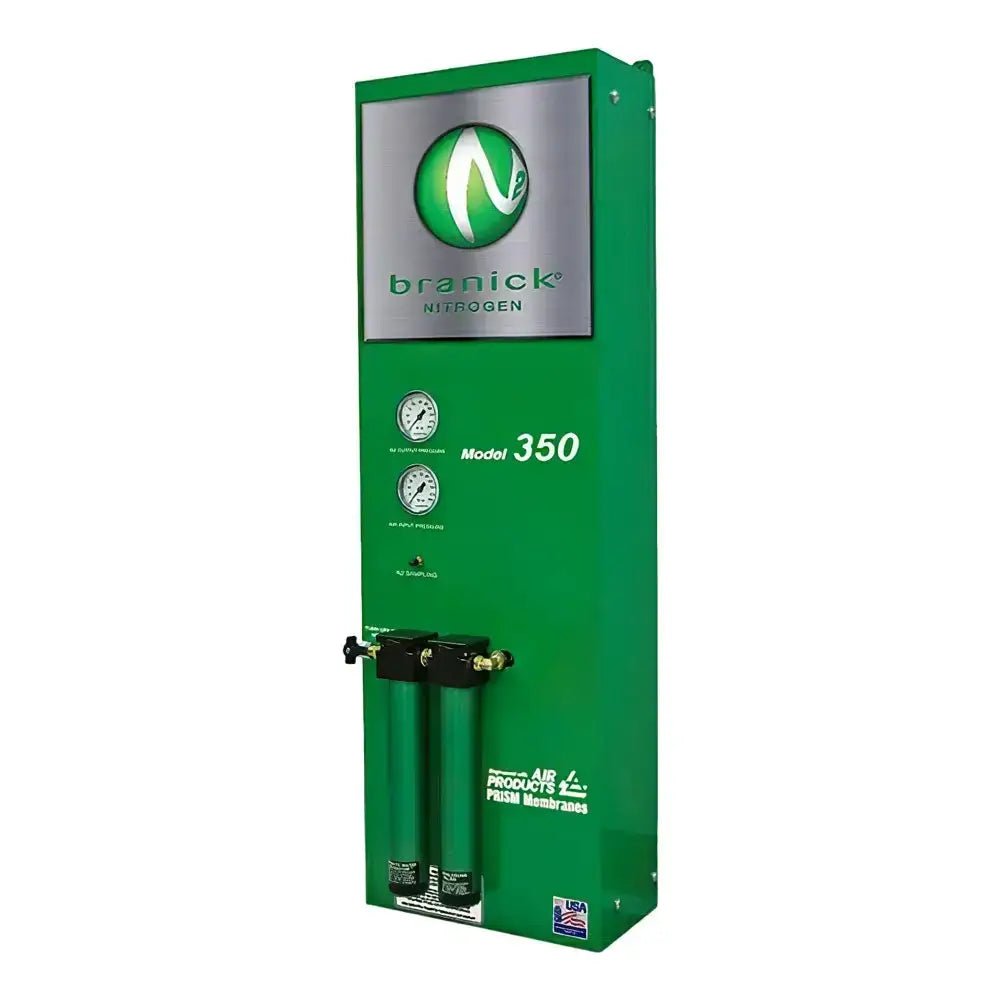
BRANICK Nitrogen Generator, 350, 110-150 psi Range, Single Membrane
BRANICK Model 350 Nitrogen Generator - Compact Wall-Mount System for Light-Duty Tire Service
The BRANICK Model 350 is a compact, wall-mounted nitrogen generator using single PRISM membrane technology to deliver high-purity nitrogen for tire inflation. Built for motorcycles and passenger vehicles in space-constrained shops, this entry-level system integrates with existing compressed air infrastructure and requires minimal floor footprint while maintaining consistent nitrogen purity for tire and TPMS longevity.
Key Features & Benefits
Single PRISM Membrane Technology
The Model 350 employs a proven single hollow-fiber PRISM membrane platform that's identical to the membrane design used in BRANICK's larger capacity tower and cart systems. This consistent engineering approach delivers 95% nitrogen purity under baseline operating conditions while maintaining reliable performance across light-duty and moderate-use tire service applications.
Traditional entry-level systems often compromise on membrane technology or use lower-cost separation materials that produce inconsistent purity. The 350 addresses this challenge by deploying the same proven membrane technology that commercial-scale systems rely on, ensuring clean, dry nitrogen without requiring multiple membrane stages.
This enables small shops to offer professional-grade nitrogen service with the same purity standard that large dealer networks provide. The shared technology platform also creates a clear upgrade path if your shop's nitrogen demand grows.
Space-Saving Wall-Mount Configuration
Unlike cart-based or tower systems that consume 15-30 square feet of valuable floor space, the Model 350 mounts directly to a shop wall using standard anchor bolts. The compact cabinet measures 13.06 inches wide by 20.88 inches deep by 48.75 inches tall, delivering a true zero-floor-footprint installation that maintains full access to service bays and equipment movement paths.
Space constraints are a common challenge in small tire shops, independent garages, and multi-service facilities where every square foot impacts operational efficiency. Wall-mounting eliminates the need to relocate equipment, reorganize service bays, or sacrifice customer waiting area space to add nitrogen capability.
This enables shops of any size to add nitrogen as a value-added service without construction or facility reorganization. The fixed wall installation also improves long-term safety by securing the unit to building structure rather than rolling casters.
Integrated Pre-Filtration and Air Drying
The Model 350 includes dual pre-filter stages—a coalescing filter and a particulate filter—that remove oil mist, water vapor, and solid contaminants from shop compressed air before nitrogen separation. Combined with the membrane's natural drying behavior, this integrated filtration system delivers nitrogen at a -70°F dewpoint, ensuring dry, clean gas that protects tire integrity and TPMS sensors.
Contaminated air is a common problem when shop compressors supply directly to tire inflation. Oil carryover can damage TPMS sensors and create long-term tire degradation, especially in high-humidity environments. Traditional tank-delivery nitrogen systems offer no filtration advantage over pre-filtered membrane systems.
This enables consistent tire and sensor protection across every fill without special training or manual intervention. Regular filter replacement (typically annual maintenance) maintains this performance, and the 5-year membrane warranty covers the core separation component when maintenance procedures are followed.
Flexible Compressed Air Supply Integration
The Model 350 operates across a wide input pressure range of 100-175 psi and requires only modest air flow (approximately 6.3 scfm at baseline conditions). This compatibility profile means the unit integrates seamlessly with most existing shop compressor systems without requiring major air-system upgrades, new air lines, or additional electrical capacity.
Many entry-level shops operate older or modest-capacity compressors that would be overwhelmed by tower or larger cart-based systems. The 350's flexible input requirements address this by working within typical small-shop air infrastructure, making nitrogen capability accessible without capital investment in new compressor equipment.
This simplifies installation and reduces total project cost by eliminating compressor upgrades. The flexible pressure range also accommodates natural pressure variations throughout the day without triggering system shutdowns or requiring specialized regulators.
Extended Membrane Warranty Protection
The Model 350 carries a 5-year warranty on the PRISM membrane from date of delivery, provided that filter maintenance requirements and oil-free air specifications are met. This extended coverage reflects the expected service life and reliability of the core separation component under normal operating conditions, and it significantly exceeds the typical 1-year general warranty structure of entry-level competitors.
Membrane replacement represents the primary capital expense for long-term nitrogen generator operation. Industry-standard systems often provide only 1-year general coverage, shifting replacement risk to the shop after year one. The Model 350 shifts this risk back to the manufacturer, providing peace-of-mind coverage that aligns with actual component lifespan.
This protects your investment by ensuring membrane replacement—if needed—is covered under warranty for half a decade. The 5-year term also signals BRANICK's confidence in the PRISM technology and encourages proper maintenance by tying warranty coverage to filter replacement and air-quality requirements.
Made-in-USA Manufacturing and Brand Heritage
BRANICK manufactures the Model 350 in the United States, applying the same engineering standards and quality controls that define the company's product line across tire service equipment. This domestic manufacturing approach supports local supply chains, simplifies parts availability, and provides a known brand heritage for shops seeking reliable, domestically-produced equipment.
Import-based nitrogen generators are common in the entry-level market, and sourcing problems or support delays can create extended downtime when service is needed. Domestic manufacturing provides consistent parts availability and direct support relationships with a manufacturer that has served the tire industry for decades.
This enables faster repairs, easier parts sourcing, and direct access to technical support. Made-in-USA production also appeals to shop owners and operators who prioritize local sourcing and domestic supply chain resilience.
Product Demonstration
Applications & Use Cases
- Motorcycle and Passenger Vehicle Tire Service: Designed specifically for light-duty tire inflation in dealerships and independent shops serving motorcycles, sedans, and standard passenger vehicles with routine tire maintenance and seasonal changeovers.
- Small Tire Dealerships: Entry-level nitrogen service option for independent tire retailers and multi-brand shops seeking to add nitrogen as a value-added service without floor space investment or major equipment capital expenditure.
- Multi-Service Garages and Repair Shops: Compact installation for general service facilities that perform occasional tire service alongside engine repair, maintenance, and diagnostics while maintaining operational flexibility in service bay layout.
- Space-Constrained Service Bays: Wall-mounted configuration for shops with limited floor area, crowded service environments, or mobile service trucks where traditional cart or tower systems are impractical or operationally disruptive.
- Light to Moderate Nitrogen Demand: Suitable for operations performing 10-30 nitrogen fills per day or seasonal nitrogen service during tire changeover periods, where full-scale tower system capacity would exceed actual demand.
Technical Specifications
| Specification | Value |
|---|---|
| Nitrogen Output Flow | 3.2 scfm at 95% purity |
| Nitrogen Purity | 95-99.9% N2 |
| Air-to-Nitrogen Ratio | 1.9:1 |
| Outlet Pressure Range | 110-150 psi |
| Dewpoint | -70°F |
| Specification | Value |
|---|---|
| Input Pressure Range | 100-175 psi |
| Air Supply Flow | 6.3 scfm at baseline conditions |
| Air Compressor Type | Clean, dry, oil-free compressed air required |
| Specification | Value |
|---|---|
| Width | 13.06 inches (331 mm) |
| Depth | 20.88 inches (530 mm) |
| Height | 48.75 inches (1,238 mm) |
| Weight | 120 lb (54.4 kg) |
| Specification | Value |
|---|---|
| Operating Temperature | 40°F to 150°F (4°C to 65°C) |
| Compressed Air Inlet | 3/8" NPT female |
| Nitrogen Outlet | 3/8" NPT female |
| Sampling/Purity Port | Front-mounted |
What's Included
- Wall-mountable generator cabinet with single PRISM membrane and integrated pre-filtration system
- Dual pre-filter assembly (coalescing and particulate filters for integrated air treatment)
- Front-mounted controls and gauges including nitrogen sampling/purity port for quality verification
- Installation and operation manual with mounting specifications, air-quality requirements, and maintenance procedures
Note: Nitrogen storage tank, hoses, inflation chucks, and air compressor are sold separately. Call to confirm included accessories and component specifications.
Installation Requirements
Wall Mounting & Location
- Mounting Surface: Mount to solid, level wall using 3/8" anchor bolts through designated mounting tabs. Ensure structural wall integrity and stable installation surface.
- Environment: Install in well-ventilated, non-hazardous area free from explosion or fire risks. Maintain clearance from combustible materials and flammable liquids.
- Access: Position unit to allow convenient access to front gauges, sampling port, controls, and filter replacement openings.
Compressed Air Supply Requirements
- Air Quality: Supply clean, dry, oil-free compressed air only. Oil contamination in the membrane will void warranty coverage. Use appropriate oil traps or compressors with oil-free output.
- Air Pressure: Source must deliver compressed air within 100-175 psi range. Pressures outside this range will degrade performance or trigger system shutdown.
- Air Piping: Use steel, copper, or aluminum air lines (never plastic for primary lines). Maintain minimum distance of 30 feet from air compressor to allow cooling and additional moisture condensation before reaching the Model 350.
- Filtration & Drying: Install pre-filtration or after-cooler system on the air compressor output to ensure clean, dry air delivery. This protects both the membrane and system performance.
Electrical Requirements
- Electrical Power: Confirm specific electrical requirements with manufacturer documentation included with the unit. Electrical specifications vary by installation configuration and should be verified before installation begins.
- Power Connection: Ensure adequate outlet availability and proper circuit capacity for the model you've selected. Contact technical support or reference installation manual for exact amperage and voltage specifications.
Installation Notes
- Permits: Verify local code compliance and any required permits before installation. Some jurisdictions have specific safety or pressure vessel regulations for compressed air equipment.
- Professional Installation: Installation should be performed by qualified personnel familiar with compressed air systems and industrial equipment mounting practices.
- System Pressure Testing: After installation, verify that all air line connections are secure and test the system for pressure integrity before operation.
Shipping & Delivery
Freight Coverage
Shipping: Complimentary LTL (less-than-truckload) freight delivery to commercial addresses within the 48 contiguous United States. Surcharges apply to rural locations, limited-access addresses, and non-commercial destinations.
Delivery Timeframe: 1-2 weeks from order placement, subject to inventory availability and regional freight routing.
International: International shipping requires special arrangement through authorized distributors. Contact technical support for availability and pricing.
Delivery Requirements
Equipment Required: Receiver must have forklift or equivalent lifting equipment available (minimum 500 lb capacity) to unload unit from delivery truck. Curbside delivery only; inside placement requires additional service arrangement.
Delivery Type: Standard delivery with commercial dock or forklift-accessible receiving area. Residential or limited-access locations may require lift-gate service at additional cost; call to arrange.
Receiving: Inspect all packages before signing the bill of lading. Document any visible damage on the BOL before the driver departs to protect freight damage claims.
Damage Reporting
Within 15 days: 100% coverage for concealed damage replacement parts and freight costs
15-30 days: 50% coverage for replacement parts and freight costs (shared cost with customer)
After 30 days: No coverage (customer responsible for all parts and freight)
Warranty Coverage
Standard Warranty Program
1 Year - General Parts & Labor: Covers defects in materials and workmanship on all components except the membrane, including all mechanical systems, gauges, and controls. Includes labor for repair or replacement of defective parts.
5 Years - Nitrogen Membrane: Covers the PRISM membrane separation component against defects in materials and workmanship, provided that filter maintenance requirements are met and clean, oil-free air supply is maintained. This extended coverage exceeds typical 1-year industry standard for entry-level systems and reflects the expected service life of the core separation component.
Warranty Requirements & Conditions
Eligibility: Warranty is valid for the original purchaser (non-transferable) from date of delivery. Transferability to subsequent owners may be available; contact manufacturer for details.
Installation: Installation must be performed according to the manufacturer installation manual by qualified personnel. Improper installation or mounting voids all warranty coverage.
Air Quality: Warranty coverage requires clean, oil-free compressed air supply. Oil contamination or use of contaminated air sources automatically voids all coverage.
Maintenance: All regular filter replacement and maintenance procedures outlined in the operation manual must be followed to maintain warranty coverage. Failure to perform scheduled maintenance voids warranty protection.
Exclusions: Warranty excludes damage from misuse, improper installation, contamination, non-approved repairs, or use outside specified operating parameters. Exact terms and claim procedures are defined in the manufacturer's official warranty documentation and owner's manual included with the unit.
Ready to Add Nitrogen Service to Your Shop?
Our team can help you select the right nitrogen generator for your facility, verify installation requirements for your shop environment, and confirm accessory compatibility. Get expert guidance on setup, operations, and technical specifications.
Frequently Asked Questions
What is the nitrogen output flow rate of the BRANICK Model 350?
The Model 350 delivers up to 3.2 scfm (standard cubic feet per minute) of nitrogen at 95% purity under baseline operating conditions of 125 psi input pressure and 75°F ambient temperature. Output varies slightly with changes in input pressure or temperature.
What compressed air supply do I need for the Model 350?
The Model 350 requires clean, dry, oil-free compressed air delivered within 100-175 psi pressure range. Air flow requirement is 6.3 scfm at baseline conditions. Most small shop compressors can supply this without upgrades; verify your system pressure and capacity before ordering.
What is included with the Model 350 nitrogen generator?
The package includes the wall-mountable generator cabinet with single PRISM membrane, integrated dual pre-filter system (coalescing and particulate filters), front-mounted gauges and controls with sampling port, and complete installation and operation manual. Nitrogen storage tank, hoses, inflation chucks, and air compressor are sold separately.
Can the Model 350 be mounted on any wall?
The unit must be mounted to a solid, structurally sound wall using 3/8" anchor bolts through designated mounting tabs. The wall must be level and able to support 120 lb. Avoid mounting in hazardous areas or near flammable materials. Ensure adequate clearance for gauge access and filter replacement.
What nitrogen purity does the Model 350 deliver?
The Model 350 delivers nitrogen at 95% purity under standard operating conditions, with the potential to reach up to 99.9% purity under ideal conditions. This level of purity protects tire integrity and TPMS sensors while meeting industry standards for tire service applications.
What warranty coverage does the BRANICK Model 350 include?
The Model 350 includes a 1-year general warranty on parts and labor covering all components except the membrane, plus a 5-year warranty on the PRISM membrane component. The 5-year membrane warranty applies when filter maintenance is performed regularly and clean, oil-free air is supplied to the unit.
How much space does the Model 350 require for installation?
The Model 350 measures 13.06 inches wide by 20.88 inches deep by 48.75 inches tall and mounts directly to a wall, using zero floor space. This compact profile makes it ideal for space-constrained tire shops and service bays where floor footprint is a concern. Ensure adequate clearance for filter access and maintenance.
What applications is the Model 350 suitable for?
The Model 350 is designed for light-duty nitrogen tire inflation in small tire shops, independent dealerships, and multi-service garages serving motorcycles and passenger vehicles. It's ideal for operations with moderate nitrogen demand (10-30 fills per day) or seasonal nitrogen service. Call to discuss your specific application requirements.
About the Brand